.png)
The area extends north from the No 2 shaft of the Elizabeth Mine and is underlain largely by granitic rocks (see accompanying map and legend). One mine shaft and several mineralized veins and showings of the Elizabeth Mine are located immediately south in gabbro at the west margin of the Steep Rock greenstone belt (Figure 2).
Granite (unit 15) occurs as large oval masses north of and including the present study area. The granite bodies have intruded older tonalitic and gneissic rocks that are extensive north of the present area. Granite also intrudes gabbro and metavolcanic rocks of the western Steep Rock Lake greenstone belt. Several textural and compositional varieties of granite are recognized in the field as distinguished by separate codes on the map (e.g. 15b, t) and are described in the legend. Most granite is coarse grained, massive and pink being composed largely of plagioclase, K feldspar and quartz with a few percent biotite. Dikes of granite and granite-aplite cut other rock-types; conversely variably assimilated inclusions of most other rock units are found in granite.
A weak foliation defined by alignment and long axes of quartz and biotite can be discerned in some granite outcrops. Although variable, the foliation is north to north easterly and roughly parallel to the gabbro contact. The foliation tends to be well developed at the gabbro contact and in the north-trending zones of shearing and alteration (see map).
Granite is cut by dikes of lamprophyre in the present area. Lamprophyre is a massive to weakly foliated intermediate rock with mafic phenocrysts of biotite. The lamprophyre dikes have sharp boundaries and are composed of brownish-weathering and slightly recessive material. Most dikes strike northerly with widths ranging from .01 to 1.0 m. Lamprophyre dikes are the youngest magmatic rock in the area and crosscut at least some quartz veins.
Gabbro occupies a roughly 100 m-wide band at the margin of the Steep Rock greenstone belt and also occurs as smaller units farther south within volcanic rocks (Figure 2). The gabbro is fine to medium-grained, massive to foliated and dark green to black. Gabbro is composed of hornblende and plagioclase with a small proportion of foliated and probably chloritic material. Locally, fine-grained and strongly foliated to gneissic mafic rock is noted and possibly represents metavolcanic remnants within the gabbro. Large, oval plagioclase megacrysts (5 cm diameter) are observed within the gabbro mainly within a few meters of the granite contact.
At least two generations of gabbro intrusions are recognized by crosscutting relations at the Elizabeth Mine and also regionally (see late and early gabbro in Figure 2). The younger of the gabbro generations is distinguished by a homogeneous and equigranular distribution of minerals and is possibly more felsic than the older gabbro. Rare gabbro dikes mapped within granite probably represent the younger of the two gabbro generations. Both generations of gabbro are metamorphosed and cut by quartz veins.
Intermediate metavolcanic rocks occur extensively south and east of the present area. Intermediate to felsic fragments are observed although the most common variety of intermediate metavolcanic rock is a fine-to medium-grained plagioclase-phyric material that possibly represents a crystal tuff. Some outcrops of this intermediate rock are remarkably massive and homogeneous potentially having originated as an intrusive magma.
Mafic metavolcanic rocks are mineralogically similar to gabbro and are distinguished from gabbro by a fine grainsize and lack of the massive equigranular texture of gabbro. The mafic metavolcanic rocks occur as large units south of the present area and locally as small units within gabbro. Mafic metavolcanic rocks are recognized in the field as foliated and banded mafic rocks with cm-scale bands weathering as ridges and hollows. Possibly the bands developed as the mafic lava flowed or was subsequently metamorphosed. Pillows are rare.
Brittle deformation and alteration
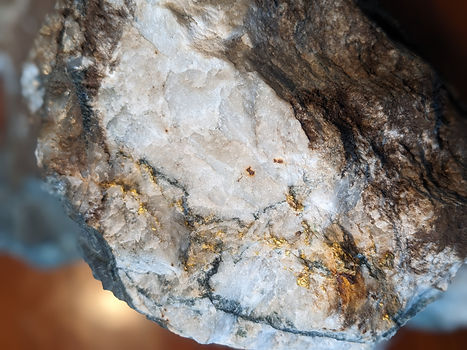
Brittle fractures crosscut all rocks and evidently developed late in the structural evolution of the area after rocks cooled and embrittled. Although many fractures are barren, others acted as conduits for fluid movement and were filled with minerals such as quartz with accessory chlorite, carbonate, sulphides and even gold. Fluid movement through fractures has also caused alteration of the wall rocks of fractures. Small alteration zones are recognized as intervals adjacent to fractures within which wall rocks are changed in colour (granite is normally reddened or bleached) and primary minerals such as biotite and plagioclase are changed to chlorite, sericite and carbonate. Rarely, accessory sulphide minerals are developed in alteration zones and are considered to be desirable pathfinders to gold mineralization.
A large but poorly defined zone of alteration and brittle deformation extends northerly from the No 2 shaft of the Elizabeth Mine (see accompanying map). This zone is up to 10 m wide but extreme northern and southern ends of the zone are not well defined by mapping due to poor exposure of bedrock. Southward, the alteration zone possibly extends under the No. 2 shaft and connects with mineralized veins that were historically mined. The northern extent of the zone (north of 5405900 m on accompanying map) is unknown. Veins of white to grey quartz (up to 1 m wide) are common within the zone and the granitic host rock is altered with enrichment in quartz, chlorite, sericite and carbonate at the expense of plagioclase and K feldspar. This interpretation of an altered zone is supported by spectrometer measurements which generally show low percentages of K (1 to 2 %) within the alteration zone compared to about 3% in granite elsewhere (see values posted on accompanying map).
The altered granite and gabbro within the zones tend to be strongly foliated and crenulated probably due to shearing. Quartz veins, although locally boudinaged and recrystallized, are mainly massive and appear to have post-dated the shearing. Little is known about the kinematics and overall amount of slip on this zone of shearing and alteration.
A second zone of alteration characterized by a stock work of quartz veins within reddened and altered granite extends northerly near the eastern contact of the intrusion (see Figure 2 and accompanying map). A linear escarpment on the west side of this alteration zone is suggestive of a north-trending brittle fault at the base of the escarpment. A large cleared outcrop on the escarpment is cut by 3 narrow brittle faults that are possibly connected to the larger structure at the base of the escarpment (see location of the outcrop and faults at 593100 m E and 5406000 m N on the accompanying map). The brittle faults are meter-wide zones of highly fractured and rusty rock with quartz veins and accessory pyrite.

Figure 2: Geology of the Elizabeth Mine area. Historic shafts and some mineralized veins are shown.
References
Stone, D. (2016). Geology and gold exploration 2016: Northern Elizabeth Mine area. Fern Elizabeth Gold Exploration Ltd.